







Want to fix it so your garage band rocks the neighborhood?
Want to solder the faulty wire on your old phonograph so you can play those 60s albums you’ve kept all this time?
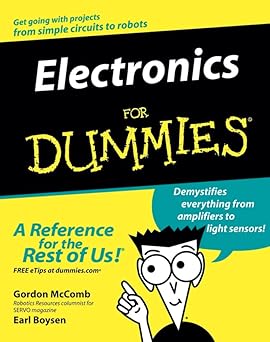
Whether you’re a do-it-yourselfer , hobbyist, or student , this book will turn you on to real-world electronics. It quickly covers the essentials, and then focuses on the how-to instead of theory. It covers:
- Fundamental concepts such as circuits, schematics, voltage, safety, and more
- Tools of the trade, including multimeters, oscilloscopes, logic probes, and more
- Common electronic components (e.g. resistors, capacitors, transistors)
- Making circuits using breadboards and printed circuit boards
- Microcontrollers (implementation and programming)
Author Gordon McComb has more than a million copies of his books in print, including his bestselling Robot Builder’s Bonanza and VCRs and Camcorders For Dummies. He really connects with readers! With lots of photos and step-by-step explanations, this book will have you connecting electronic components in no time! In fact, it includes fun ideas for great projects you can build in 30 minutes or less. You’ll be amazed! Then you can tackle cool robot projects that will amaze your friends! (The book gives you lots to choose from.)
Students will find this a great reference and supplement to the typical dry, dull textbook. So whether you just want to bone up on electronics or want to get things hooked up, souped up, or fixed up,…whether you’re interested in fixing old electronic equipment, understanding guitar fuzz amps, or tinkering with robots, Electronics For Dummies is your quick connection to the stuff you need to know.
Read more






J. R. Cardona –
It’s an excellent book, it’s the best one of the books with this title (there are several, beware, this is the only good one!)
It doesn’t require any initial knowledge and explains everything greatly.
If you want a book to begin doing electronics from scratch, and from zero level, this is your book!
LindaM –
Great beginners handbook and ready reference, easy to navigate
D. Evans –
Decided to teach myself electronics and after reading many reveiws i purchased this book on the subject. So far it has been clear and concise in its explanations and diagrams. Gives a good solid basic grasp of electronics with lots of helpful information which I have found very useful and pretty good in being pretty loose in that you can jump around the book and start with different parts.
Page 202 has a starter list of needed/recomended parts as pretty daunting trying to find a kit with the right selection of parts etc (found one on ebay £18)
The theory can be heavy, and yes there are some scary equations but they ae nicely explained and you can always come back to those parts. Its been 20 years since i have used algebra but have found it well done if you take it a bite at a time, and as the book states you can skip some sections as you don’t need to know some parts unless you are going to go in depth into that area of electronics.
If you want to get into electronics then this is certainly worth the £10
TechToo –
This is the perfect book for gaining an understanding of the basics and the buzz words of today’s electronic world. It covers everything from the how and why of electronic components (parts) and circuits (parts connected together to perform a desired result) to symbols, schematic reading, meter and oscilloscope use, tools, and more. Did you know that a choke, coil, and inductor are all the same physical component and why it’s referred to with 3 different names? “Electronics for Dummies” is a book less on theory and more on practical. It includes breadboarding, creating projects and printed circuit boards–from 30-minute projects to a basic microcontrolled robot–all clearly explained and easily understood. After finishing this book, you won’t be a rocket scientist, but you certainly will have a basic understanding of electronics–enough to gain a confidence for further study or enough to be an informed component in today’s world of circuits.
Heike Freund-Hahn –
Das Buch ist Spaß pur! Es führt von “eigentlich keine Ahnung” zu “na also, es geht doch”. Richtig guter Einstieg.
Berg –
Once you’ve finished this book you’ll know what components do and lots of useless information about them but you still won’t know how to put a circuit together beyond the battery/lamp stage.