







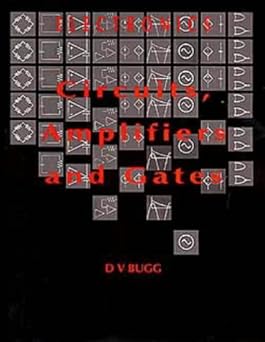


Microelectronics has revolutionised technology over the last 15 years and no end is in sight to new developments. It is a tool needed by every engineer and research physicist. Yet all too often, details obscure simple principles. Electronics: Circuits, Amplifiers and Gates remedies this with a comprehensive but easy to understand account covering all the basic ideas. It is aimed at first and second year physics or electrical engineering students at universities and polytechnics. The thoroughness of the treatment provides a tremendous grounding which will lead you on to higher level applications. The textbook assumes only a knowledge of O/GCSE level physics and basic calculus. It leads you through a host of subjects including DC and AC circuits and complex numbers, operational amplifiers, digital logic, diodes, transistors, integrated circuits, filters, Fourier analysis and control systems. Illustrated throughout with a wide selection of problems and worked examples, Electronics: Circuits, Amplifiers and Gates will prove to be an essential guide in your passage through the maze of learning needed to really understand electrical systems and electronics.
The Author. David Bugg has been Professor of Physics at QMW, London since 1970. He has been responsible there for the development of joint honours courses covering both Physics and Electrical Engineering, and has had wide experience also in Cambridge, Vancouver, Brisbane and the United States. He is active in research in both experimental particle physics and the application of phase-locking ideas to a variety of phenomenological problems.
Read more








laser_mechanic –
Not enough examples, no answers to the problems, which is a bit frustrating. His approach to not using laplace transforms but to introduce block diagrams in control systems is an excellent idea.
I do not know if I want to purchase the new edition, since it is probably more of the same.
Brad Camroux –
D V Bugg’s “Electronics: Circuits, Amplifiers and Gates” may serve as an excellent starting point for people interested in pursuing electronics on their own. It should not be used as a text on fundamental circuit theory, however, as there are a few errors in the figures and formulae (in my version, anyway; hopefully they’re corrected in more recent printings, or there is hopefully an errata page somewhere).
Contents:
1. Voltage, Current and Resistance
2. Thevenin and Norton
3. Capacitance
4. Alternating Current; Bandwidth
5. Inductance
6. Complex Numbers and Impedance
7. Operational Amplifiers and Negative Feedback
8. Integration and Differentiation
9. Diodes and Transistors as Switches
10. The Field-Effect Transistor (FET)
11. Gates
12. Combinational Logic
13. Sequential Logic
14. Resonance and Ringing
15. Fourier’s Theorem
16. Active Filters
17. Equivalent Circuits for Diodes and Transistors
18. Transistor Amplifiers
19. Oscillators
20. Control Systems and Synchronisation
21. Digital Circuits
22. Transformers and Three-Phase Supplies
Monique –
Good
Jacky –
Book in good condition.